
Business Quality: How to Recognise a Good Business

Dr. Simon Lichte
Published on
Both of our screeners so far revolve around price. The Magic Formula looks for cheap companies that use their capital efficiently, Multi-Factor Value looks for companies with low valuations from four angles. Both answer the same basic question: what am I getting for my money?
The Business Quality screener asks the opposite question. It is not interested in what a share costs, but in what the company behind it is actually worth having. At first that sounds like a matter of taste, since everyone considers different firms good. Which is exactly why it is worth defining properly what "quality" in a company is supposed to mean.
What Makes "Quality" Measurable
The answer this screener is built on comes from one of the better known pieces of recent financial research. In Quality Minus Junk, Clifford Asness, Andrea Frazzini and Lasse Pedersen proposed a definition that deliberately does not rest on gut feeling.
Their starting point is a simple thought: a quality company is one that a sensible investor should be willing to pay more for. And from that you can derive which characteristics are meant. A company is worth more if it earns high profits, if it improves over time, and if its risk stays manageable. In the study, those become the pillars of profitability, growth and safety.
What matters about this definition is that it consists entirely of business figures. No assessment of management, no industry fantasy, no forecast. Only what is written in the accounts of the past few years.
Pillar 1: Profitability
The first question is: how much profit does the company extract from what it has?
A single profit figure is not enough for that, because it says nothing about the effort behind it. So profit is set in relation to other things, among them total assets, equity and revenue. A company that pulls 20 million in gross profit out of 100 million in assets operates differently from one that needs 500 million to do the same.
One metric in this pillar deserves its own explanation, because it does the opposite of what you would expect: accruals. They are the difference between reported profit and the money that actually flowed out of the operating business. The bigger that gap, the more the profit rests on accounting entries and the less on money received. For this metric, therefore, a lower value is better. A company whose profit is backed by cash flow stands on firmer ground than one where the two figures drift far apart.
Pillar 2: Growth
A clarification is important here, because the term can mislead. What is meant is not that revenue has risen. What is meant is that profitability has improved.
The screener takes the same metrics from pillar 1 and compares them with where they stood five years ago. Does the company earn more today from the same assets than it did back then? Have margins improved? Has the quality of its profits gone up?
That distinction is the real substance of this pillar. Revenue can almost always be increased if you are willing to deploy enough capital or cut prices to get it. A company that extracts more from the same input year after year, on the other hand, has genuinely improved something. Five years is deliberately a long window, because nothing short-lived survives a stretch that long.
Pillar 3: Safety
The third question is: how likely is it that this company runs into trouble?
Four things feed into this. Debt relative to assets shows how much room a company has in a bad year. The volatility of profits over recent years shows how dependable the business is, because a company with stable earnings springs unpleasant surprises on its owners less often. Beta measures how sharply the share swings compared with the market as a whole. And insolvency measures such as the Altman Z-Score condense several balance sheet items into a single figure for financial resilience.
This pillar tends to be underrated. It measures no opportunity. What it does is prevent a specific mistake: a highly profitable company landing near the top on its profit figures alone, even though it bought those profits with heavy debt and the fragility that comes with it.
Our Addition: Return on Capital
To these three pillars we add a fourth measure, return on invested capital, or ROIC. It sets operating profit after tax against the capital tied up in the business.
The thinking is the same as with Greenblatt: a company that makes a lot of profit from little capital needs fewer resources to grow and usually has an advantage competitors cannot easily catch up with. This metric is not part of the original study, it is our extension. Where it cannot be calculated, the assessment rests on the study's three pillars.
We say this explicitly because the separation matters: what comes from the research, and what we added, should be something you can tell apart.
How Many Metrics Become One Number
In our other two screeners, rank positions are added together. The Business Quality screener uses a different procedure, because considerably more metrics come together here and they are spread across four groups.
Each individual metric is therefore first converted into a comparative value that shows how far a company sits from the average of all the companies examined. The average is zero. A positive value means better than average, a negative one worse, and the size of the number says how pronounced the gap is.
This intermediate step is necessary so that things measured in completely different units become comparable. A margin in percent, a beta with no unit and a debt ratio cannot simply be added together. On this shared scale they can: the values within a pillar are combined, the pillars together produce the overall assessment, and from that comes the ranking.
Quality Says Nothing About Price
That is the most important sentence about this screener, which is why it gets a heading of its own.
A company at position 1 of this ranking is a good business by the criteria described. Whether its share trades at a sensible price appears in not a single one of the metrics used. Quality companies are rarely a secret on the stock market, and that is exactly why they are frequently expensive. Buy an excellent company at too high a price and you can lose money even when the company does everything right.
From this follows the obvious way to use this screener: together with the other two. Multi-Factor Value shows you what is cheaply valued. Business Quality shows you what is worth having. Companies that sit near the top of both lists are the interesting cases, because that is where a good business meets a price that has not already anticipated everything. Greenblatt's Magic Formula is essentially the compact version of precisely this idea, with two metrics instead of many.
Who Does Not Get Ranked
A company does not appear in the ranking if one of the three pillars cannot be calculated at all, for instance because the five-year comparison data is missing or too few metrics are available. On top of that come the sectors and size classes you include or exclude through the filters anyway.
If only return on capital is missing, the company stays in the list and is assessed on the study's three pillars. Only our addition drops away in that case.
How to Use the Screener in Investiqal
In the Screening section, you select the Business Quality strategy at the top and get the ranking across the stock universe we cover.
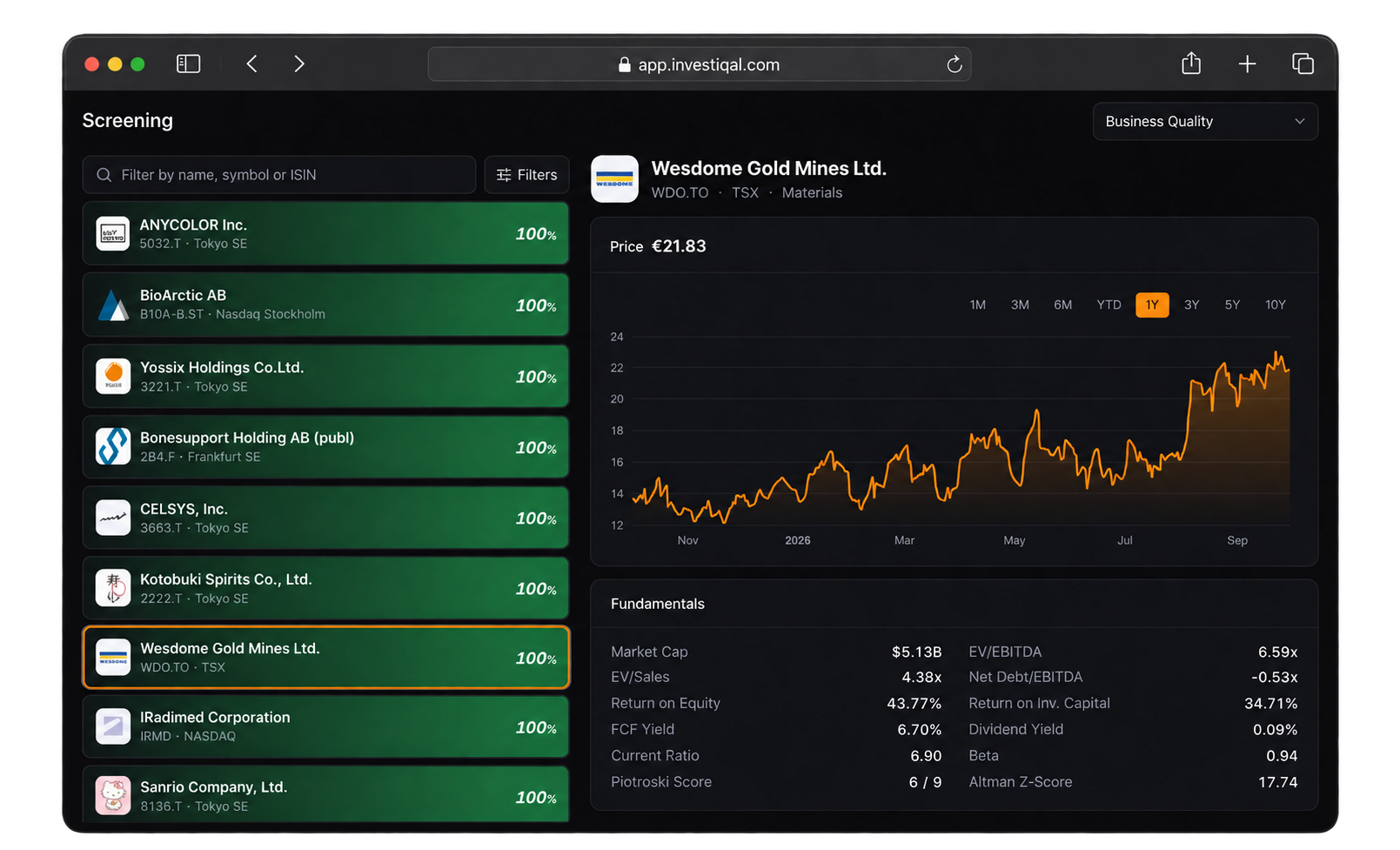
The percentage next to each company is, once again, its rank position translated onto a scale, with 100 percent standing for the best placed company in that run. It condenses all four groups into one figure and is therefore deliberately a compressed value. Two companies with the same percentage may have arrived there by quite different routes, one through outstanding profitability, the other through stability and low debt.
One note for understanding it: the value is always relative to the particular run. It compares the companies with each other and awards no absolute grade. Change the filters and the comparison group changes with them, and so does the value. A share that sits mid-table in a global comparison can be right at the front within its own sector.
What You Do With It
The Business Quality screener answers a question that is otherwise hard to answer without considerable effort: which companies operate profitably over several years, improve while doing so, and stand on solid financial ground?
What it does not take off your hands is the second half of the work. Whether the business model still holds up in ten years, whether the current valuation is defensible, and whether the company suits your investment strategy appears in no metric. But for that you now have a dependable starting list, rather than a collection of names you happened to come across somewhere.
This article explains how one analysis method works. It is neither investment advice nor an investment recommendation. Investing carries risk, up to and including the total loss of the capital you put in. Investment decisions are yours alone to make.
Ready to try Investiqal?
Sign Up